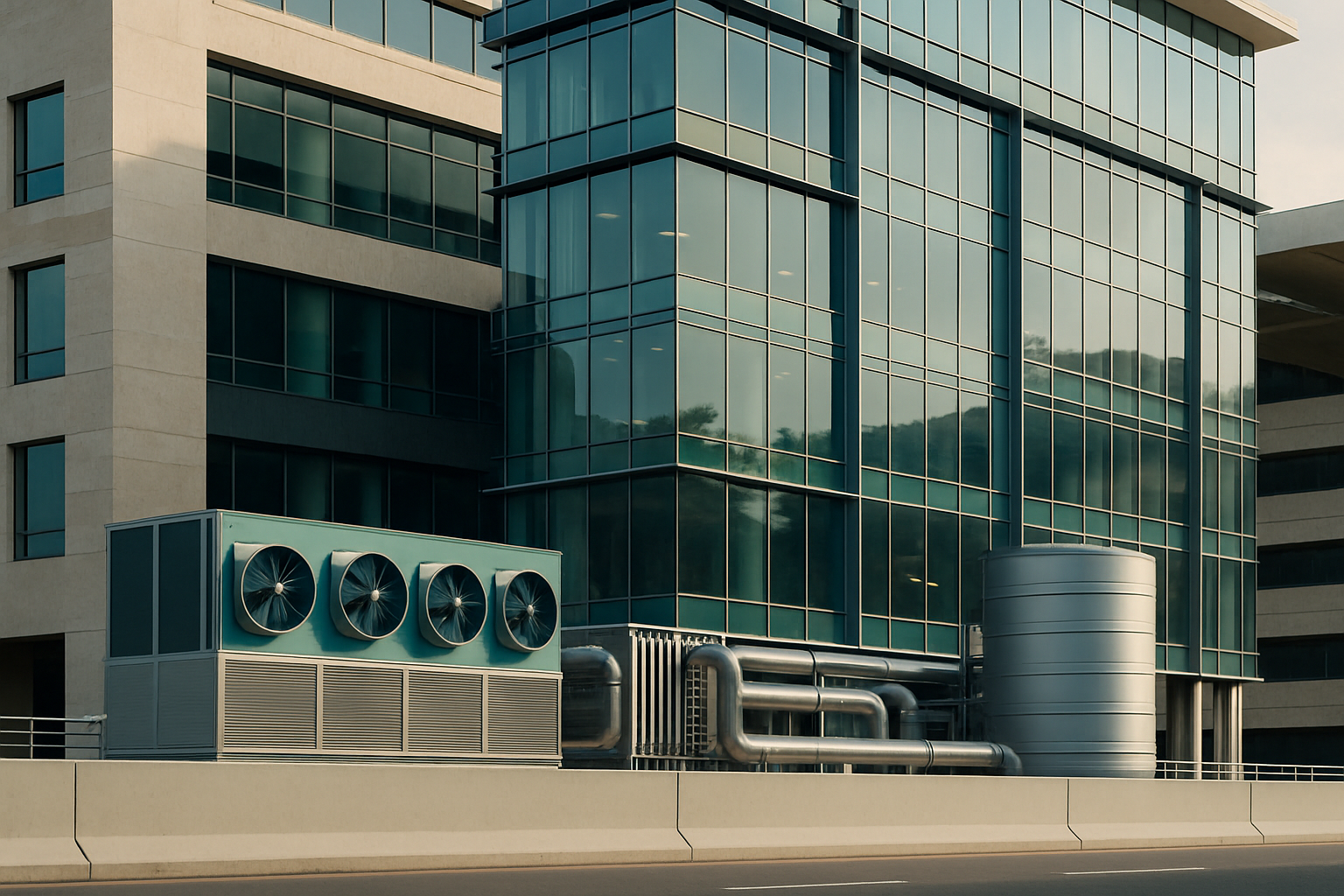
Summer is coming to an end, and while temperatures across the UAE are beginning to ease, the challenge of managing electricity demand remains. During the hottest months, thousands of buildings run their cooling systems at high capacity at the same time, creating major peaks in electricity demand. As our cities continue to grow and electricity consumption increases, managing these peak periods is becoming just as important as reducing overall energy use.
Electricity demand is not constant throughout the day. There are periods when the grid has significant available capacity and others when demand approaches its highest levels. The electricity system must be capable of meeting these peaks even when they last for only a few hours.
There are two ways to respond: continue expanding generation and network capacity to meet ever-higher peaks, or make the way we consume electricity more flexible.
Buildings can play an important role in the second approach.
It is not only about using less electricity
For years, the sustainability conversation around buildings has largely focused on energy efficiency: better insulation, more efficient equipment, LED lighting, improved controls and reducing overall electricity consumption.
These measures remain essential. But there is another question we increasingly need to ask:
Can a building change when it uses electricity?
This is the principle behind demand response.
Instead of consuming electricity in the same way regardless of what is happening on the grid, a building can temporarily reduce or shift some of its demand during peak periods.
In the UAE, cooling is an obvious place to start because it represents such a significant part of building electricity demand.
A building could, for example, pre-cool certain areas before a peak period and temporarily reduce cooling afterwards. Temperature setpoints could be adjusted slightly, fans and pumps could operate at lower speeds, chiller operation could be optimised, or stored cooling could be used when electricity demand is particularly high.
The objective is not necessarily to eliminate that electricity consumption. Some of it may simply move to another time of day. What matters is reducing pressure on the electricity system when demand is at its highest.
And importantly, this should happen without compromising occupant comfort, indoor air quality, humidity control, critical operations or equipment.
What happens when hundreds of buildings respond together?
The reduction achieved by a single building may appear relatively small. Across hundreds or thousands of buildings, however, the impact can become significant.
Imagine an office building capable of temporarily reducing part of its cooling demand for an hour. Now imagine commercial buildings, hotels, shopping centres, schools and other facilities doing the same thing at approximately the same time.
Collectively, these buildings become a flexible resource for the electricity network.
This changes the traditional relationship between buildings and the grid. Instead of being passive consumers that simply take electricity whenever it is required, buildings can begin responding to conditions within the wider energy system.
Modern Building Management Systems, smart meters, automated controls and thermal storage are making this increasingly possible.
The key word, however, is reliably.
Building owners need to understand which systems can actually be controlled, how much demand can safely be reduced, how quickly the building can respond and how long that reduction can be maintained.
It is the difference between saying,“Our building has a large cooling load,” and being able to say, “Our building can reliably reduce demand by this amount for this period without affecting its operation.”
Abu Dhabi is already moving in this direction
This is not simply a theoretical discussion about the future.
Abu Dhabi has already started establishing a regulatory framework for demand response.
The Abu Dhabi Department of Energy’s Demand Response Policy, effective from January 2024, sets targets of 80 MW of contracted demand-response capacity by 2027 and 200 MW by 2030.
Initial programmes have also demonstrated the potential scale.
According to the Department of Energy, its 2024 pilot achieved an average peak reduction of 106 MW across ten events, with a maximum reduction of 210 MW. District cooling was among the participating load categories.
A second phase launched in 2025 sought to assess and aggregate more than 250 MW of potentially flexible demand from industrial and commercial participants.
These numbers are significant because they demonstrate that demand response can move beyond individual building initiatives and become part of how electricity demand is managed at city level.
The policy direction is therefore becoming increasingly clear, even though some of the detailed commercial arrangements including payment structures, baseline calculations and settlement mechanisms are still developing.
What is in it for building owners?
For building owners, participation should not simply be viewed as another sustainability obligation.
A building’s ability to reliably reduce or shift electricity demand could become a valuable asset.
Depending on how future programmes are structured, owners may potentially be compensated for making flexible capacity available or for reducing electricity demand when requested.
The final commercial mechanisms will determine exactly how these benefits work, and owners should therefore avoid assuming specific financial returns at this stage.
But there are benefits to becoming ready even before those mechanisms are fully established.
Understanding demand response requires owners and operators to understand their buildings better: where electricity is being consumed, which systems are driving peak demand, what can be controlled and whether the building’s metering and management systems can demonstrate the results.
That information can also reveal opportunities for conventional energy savings and better building operation.
For new developments, flexibility can be considered from the design stage through appropriate submetering, open BMS interfaces, controllable equipment and, where appropriate, thermal energy storage.
Existing buildings can start more simply: identify the major electrical loads, understand when peaks occur and determine which systems could safely shift or reduce demand.
Why this will become increasingly important
Our electricity systems are changing.
Cities are growing. Cooling demand remains substantial. Electric vehicles are adding new loads. Data centres and other electricity-intensive uses are expanding. At the same time, renewable energy is becoming a larger part of electricity generation.
This creates a more dynamic relationship between supply and demand.
Solar power, for example, can provide abundant electricity during daylight hours, while demand may remain high later in the day as solar generation falls. In this type of energy system, the question is no longer simply how much electricity we consume, but increasingly when we consume it.
That makes flexibility valuable.
A future-ready building may therefore be judged not only by how energy efficient it is, but also by how intelligently it can interact with the electricity system around it.
Abu Dhabi’s emerging demand-response framework provides an early indication of this transition. Buildings are beginning to move from being passive electricity consumers towards becoming active participants in the wider energy system.
And as the UAE continues to grow while pursuing a more efficient and sustainable energy future, learning to manage the peaks may become just as important as reducing consumption itself.